Transaction fraud and AML for payment service providers across WAEMU.
See the connections. Detect the risk.
Uncover hidden connections between people, devices, merchants and agents across transactions to detect and block fraud and strengthen anti-money laundering investigations.
KYC and credit scoring capabilities can be brought forward with a partner organisation.
Block certain signals. Review the rest.
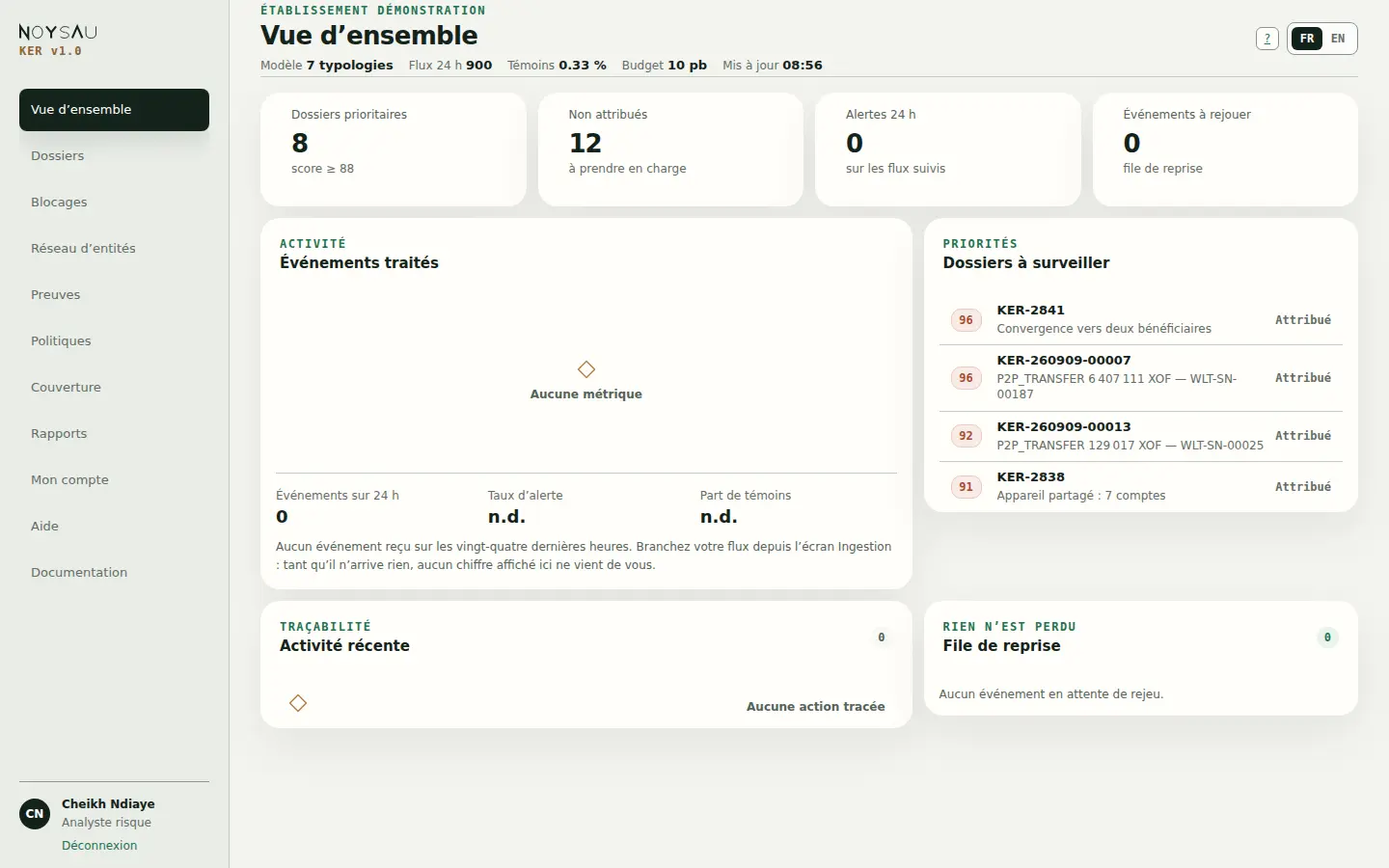
Once enabled by the institution, KER automatically holds a transaction when business rules or the score enriched with graph variables cross the authorised confidence threshold. Uncertain signals become prioritised cases.
Detect
KER checks the transaction against rules, the model and its relationship context.
Hold
A temporary measure applies to high-confidence detections within defined limits.
Review
An analyst investigates the case and a risk manager approves sensitive decisions.
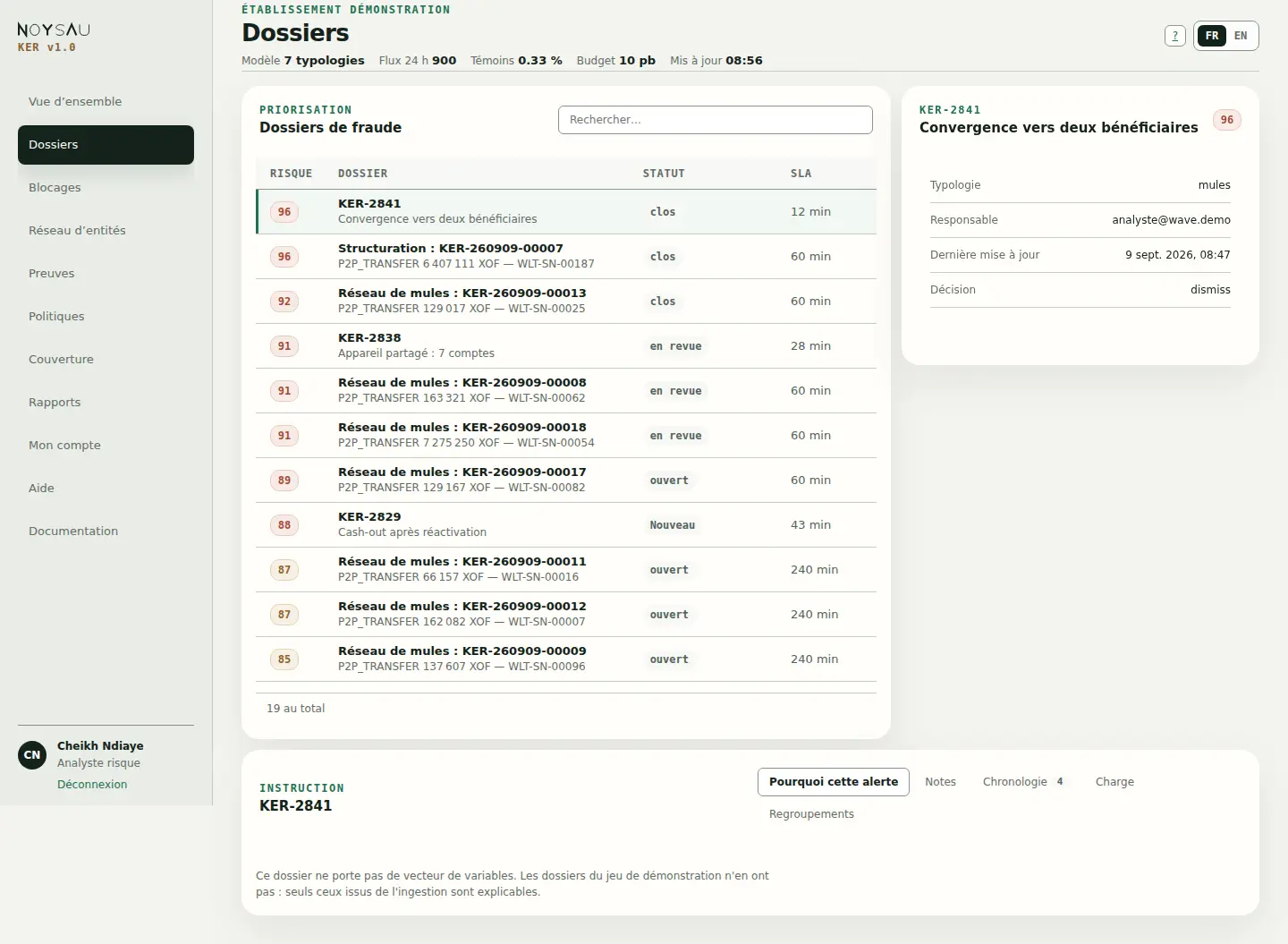
Uncertain cases follow a clear path.
The queue orders cases by risk and deadline. Analysts review facts and relationships, attach evidence and escalate to the risk manager when required.
Every decision reaches the right level.
Fraud analyst
Takes the case, explores relationships, gathers evidence and proposes a decision.
Risk manager
Monitors exposure, resolves escalations and controls review capacity.
KER administrator
Defines policies, thresholds, guardrails and access.
Relationships reveal what isolated data hides.
KER complements business rules and conventional models with graph variables. This context helps uncover patterns hidden by a single transaction and distinguish community solidarity chains from mule networks. GNN architectures are being evaluated for a later phase.
Connected accounts, devices, agents and beneficiaries.
Recurrence, circulation of funds and coordination.
Familiar solidarity, isolated anomaly or organised network.
Patterns grounded in transaction operations.
These examples come from the demonstration environment. Typologies, thresholds and measures are agreed with each institution.
Mule networkAML structuringAccount takeoverAgent collusionCircular flowsShared identity
Decisions remain governed.
KER separates policies, autonomy limits and approvals. The institution chooses what may be alerted, held or escalated.
Policies
Define scope, threshold and authorised action for each typology.
Guardrails
Cap temporary measures and define their expiry.
Dual control
Submit sensitive decisions to separate approval.
Traceability
Review connections, changes, decisions and data operations.
Start in an isolated sandbox.
The pilot uses a simulated model and synthetic data. Scope, access, success criteria and exit terms are agreed before evaluation.
Priority case
Select a fraud or AML journey that matters to the teams.
Authorised data
Limit fields and flows to the approved need.
Verifiable measures
Compare alert quality, review time and operational load.
Controlled access
Show the public sign in only after the agreed environment is deployed.
See KER on your priority journey.
The demonstration focuses on your decisions and operating constraints.